What Is Shamanic Healing?
Shamanic healing refers to healing practices associated with traditions in which a spiritual practitioner acts as an intermediary between the human community and a spirit world or other spiritual reality.
In some traditions, the practitioner may seek spiritual guidance, perform ceremonies, interpret dreams, or work with ancestral and spiritual relationships. These activities can serve personal, communal, religious, or healing purposes.
Anthropologist Donald Pollock’s overview in Oxford Bibliographies describes shamanism as a diverse set of religious phenomena in which practitioners may interact with spirits on behalf of individuals or communities. Healing is one possible role among several.
Read more: Oxford Bibliographies — Shamanism.
Shamanic healing does not have one universal method. Its meaning depends on the culture, tradition, practitioner, and context in which it is practiced.
What Does Shamanic Healing Mean?
The meaning of shamanic healing depends on the worldview behind the practice.
In some traditional cultures, illness or distress may be understood partly through spiritual relationships, community obligations, ancestral connections, or disruptions in a person’s relationship with the world around them.
A shamanic practitioner may use ritual to address these concerns within that cultural framework.
In contemporary spiritual settings, shamanic healing may instead emphasize personal reflection, symbolic journeys, connection with nature, or exploration of spiritual meaning.
These approaches should not automatically be treated as equivalent to Indigenous or traditional shamanic systems.
Shamanic healing is best understood in its specific cultural and spiritual context rather than as one standardized healing technique.
How Does Shamanic Healing Work?
In shamanic traditions, healing may involve ritual practices intended to establish contact with the spirit world, seek guidance, or restore a sense of balance.
The specific process varies, but a contemporary session may include:
- Setting an intention: The practitioner and participant clarify the concern or question being explored.
- Preparing the space: The practitioner may create a quiet setting or use culturally specific ritual preparations.
- Using ritual or rhythmic sound: Depending on the tradition, practices may include drumming, chanting, singing, movement, or other ceremonial elements.
- Spiritual journeying or contemplation: The practitioner may enter an altered state of consciousness or use guided imagery to explore a spiritual narrative.
- Interpreting the experience: Symbols, images, emotions, or perceived spiritual encounters may be discussed within the tradition’s framework.
- Reflection and integration: The participant considers what the experience means and how to apply any insights to everyday life.
Not every tradition uses all these elements, and some traditional ceremonies are specific to a community and are not intended to be replicated outside it.
These descriptions explain how certain practices are understood by their participants. They do not establish that spirits or other proposed supernatural mechanisms have been scientifically verified.
What Are the Main Types of Shamanic Healing Practices?
There is no universally accepted classification of shamanic healing. The following are examples found in some traditional or contemporary settings, not a checklist shared by all cultures.
Shamanic Journeying
Shamanic journeying is a practice in which a practitioner uses ritual, rhythmic sound, visualization, or another method to enter an altered state of consciousness.
Within the practitioner’s spiritual framework, the journey may be understood as an encounter with spiritual guides, ancestors, animals, or other beings.
From a psychological perspective, the images and experiences may also be explored as subjective experiences, memories, emotions, or symbols.
Neither interpretation should automatically be imposed on every participant.
Soul Retrieval
Soul retrieval is a concept found in some shamanic and contemporary neo-shamanic practices.
Within these frameworks, distress or a sense of disconnection may be interpreted as a loss or fragmentation of the soul, and a ritual may be performed with the intention of restoring wholeness.
This is a spiritual interpretation rather than an established medical diagnosis or scientifically verified mechanism.
People experiencing emotional distress, dissociation, or trauma-related symptoms should not assume that these experiences demonstrate that part of their soul is missing.
Spiritual Extraction
In some shamanic frameworks, spiritual extraction refers to a ritual intended to remove what the practitioner interprets as an unwanted spiritual influence or intrusive energy.
The terminology and methods vary between practitioners.
Such claims should be understood within their spiritual context rather than treated as evidence that a physical object or supernatural force is causing an illness.
Ancestral and Nature-Based Rituals
Some traditions emphasize relationships with ancestors, land, animals, plants, or the natural environment.
These practices may involve ceremony, storytelling, offerings, prayer, or other culturally specific activities.
Their meanings cannot be separated entirely from the history, values, and community in which they developed.
Drumming and Chanting
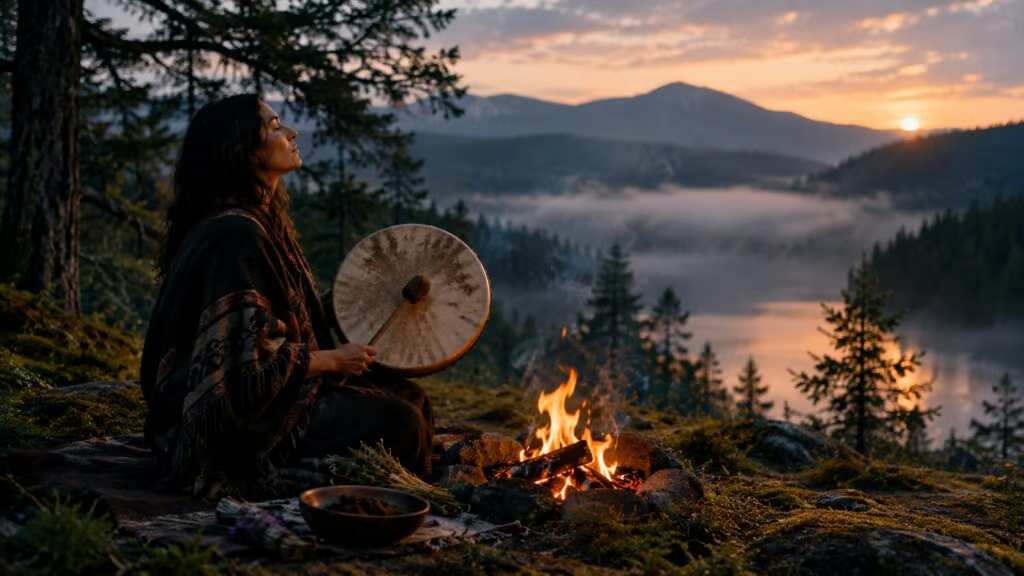
Drumming, chanting, singing, and rhythmic movement appear in some shamanic ceremonies.
Rhythm and repeated sound can influence attention and subjective experience. However, the effects of a particular ceremony depend on its full context, and the presence of drumming alone does not establish that a spiritual healing mechanism has occurred.
What Happens During a Shamanic Healing Session?
A shamanic healing session depends on the practitioner’s training and tradition.
In a contemporary session, the process may involve:
- A conversation about the participant’s intention.
- An explanation of the ritual and its boundaries.
- Drumming, chanting, meditation, or guided imagery.
- A spiritual journey performed by the practitioner or participant.
- Discussion of images, symbols, or experiences.
- Time to reflect on the session’s personal meaning.
Some traditional ceremonies may look very different and may be conducted within a wider community or religious setting.
Before participating, ask the practitioner what will happen, whether physical contact or substances are involved, and whether you can pause or leave at any time.
A responsible practitioner should respect your consent and explain any limitations of the practice.
What Does Shamanic Healing Feel Like?
People can have very different experiences during a shamanic ritual.
Some may report:
- Feeling calm or emotionally moved.
- Experiencing vivid mental imagery.
- Feeling connected to nature or their ancestors.
- Reflecting on personal memories.
- Experiencing a strong sense of symbolic meaning.
- Feeling uncertain or experiencing little noticeable change.
These experiences may be personally meaningful, but they do not all have the same explanation.
For example, vivid imagery during a ritual does not by itself demonstrate that someone has travelled to another realm. The participant’s cultural beliefs, expectations, attention, and emotional state may influence how the experience is understood.
There is no particular sensation that proves a shamanic healing session has worked.
Is Shamanic Healing Scientifically Proven?
Current clinical research is too limited to establish shamanic healing as an effective treatment for specific medical or mental health conditions.
A 2025 scoping review published in the Journal of Restorative Medicine examined shamanism as a clinical intervention. The researchers identified 16 publications, including one clinical trial, case series, and case reports. They concluded that further research is needed to understand its potential benefits.
The review also identified important limitations, including small samples, varied interventions, and limited controlled evidence. Some reported cases involved delayed conventional treatment.
Read the research: Shamanism as a Clinical Intervention: A Scoping Review — PubMed.
This means the evidence should be interpreted cautiously.
It is reasonable to investigate how ritual, cultural meaning, attention, social support, and personal belief may affect people’s experiences. It is not reasonable to conclude from preliminary reports that spiritual explanations for illness have been medically proven.
A meaningful spiritual experience is not the same as demonstrated clinical effectiveness.
Can Shamanic Healing Help With Emotional Well-Being?
Some people find shamanic rituals meaningful because they provide a structured opportunity for reflection, emotional expression, connection, or a sense of purpose.
A ceremony may help someone put an experience into words, reconsider a personal narrative, or feel supported by a community.
However, individual experiences vary, and research has not established shamanic healing as a reliable treatment for anxiety, depression, post-traumatic stress disorder, or other mental health conditions.
If you are experiencing persistent emotional distress, seek support from an appropriately qualified mental health professional. Spiritual practice may complement that support when it is safe and helpful for you.
What Is the Difference Between Shamanic Healing and Energy Healing?
Shamanic healing and energy healing can overlap in some contemporary spiritual settings, but they are not the same.
| Shamanic Healing | Energy Healing |
|---|---|
| Often centers on ritual, spiritual relationships, journeying, or culturally specific ceremonies | Often centers on a proposed vital or subtle energy |
| May involve drumming, chanting, storytelling, or spiritual guidance | May involve hands-on or hands-above-body practices |
| Can have important community and cultural roles | Often presented as an individual complementary session |
| Practices vary significantly between cultures | Practices vary by system, such as Reiki or Therapeutic Touch |
| Clinical evidence is limited and heterogeneous | Evidence varies by practice; proposed energy mechanisms are not established |
Both categories contain diverse practices, and neither should be treated as one uniform system.
For a related explanation, read Alchemical Flame’s article on Energy Healing.
What Is the Difference Between Shamanic Healing and Spiritual Healing?
Spiritual healing is a broad term for practices intended to support spiritual meaning, connection, inner peace, or a sense of wholeness.
Shamanic healing is more specifically associated with traditions and practices involving shamanic ritual, spiritual mediation, or interaction with a spirit world.
A person may explore spiritual healing through prayer, meditation, contemplation, or religious practice without engaging in shamanic traditions.
Shamanic healing can therefore be understood as one area within the wider landscape of spiritual practices, although its traditional cultural contexts deserve separate attention.
For more background, read What Is Spiritual Healing?
Is Shamanic Healing the Same as Indigenous Healing?
No. Indigenous healing traditions are diverse, and not all Indigenous healing practices are shamanic.
The word shamanism is often used as a broad comparative category in anthropology, but scholars have noted that applying it across very different societies can obscure important cultural distinctions.
A practice that developed within one community cannot automatically be treated as representative of another.
Contemporary neo-shamanic practices may borrow or adapt selected elements from different traditions. These should be distinguished from practices maintained within their original cultural and community contexts.
When learning about shamanic healing, consider the source of the practice, how it is taught, who has authority to teach it, and whether the practitioner represents its cultural context accurately.
Respectful learning requires more than using traditional symbols or ritual objects. It involves understanding the people and histories connected to them.
How Can You Explore Shamanic Healing Responsibly?
If you are interested in shamanic healing, approach it with curiosity, cultural respect, and clear personal boundaries.
1. Learn About the Specific Tradition
Ask which tradition the practitioner follows and where the practice comes from. Avoid assuming that every shamanic practitioner follows the same teachings.
2. Understand What the Session Involves
Ask about rituals, altered states, physical contact, substances, and any preparation or follow-up required.
You should understand what you are agreeing to before participating.
3. Be Cautious About Guaranteed Results
No practitioner should promise that a ritual will cure a disease, remove all trauma, or solve every personal problem.
4. Keep Medical and Mental Health Care Available
Do not stop medication, delay diagnosis, or abandon professional treatment because a practitioner attributes symptoms to spiritual causes.
5. Protect Your Autonomy
You should be free to decline an activity, ask questions, or leave a session. Be cautious of practitioners who use fear, secrecy, or financial pressure to maintain dependence.
6. Respect Cultural Boundaries
Learn from credible sources and community voices. Recognize that some ceremonies, knowledge, and practices are culturally specific and may not be intended for public use or commercial adaptation.
Frequently Asked Questions
What is shamanic healing?
Shamanic healing is a broad term for spiritual and ritual practices in which a practitioner may seek guidance or healing through relationships with the spirit world. Methods and beliefs vary significantly across cultures.
How does shamanic healing work?
Within shamanic traditions, healing may involve ritual, drumming, chanting, spiritual journeying, or ceremonies intended to restore balance. These are descriptions of spiritual frameworks, not proof of a scientifically verified supernatural mechanism.
What happens during a shamanic healing session?
A session may involve setting an intention, ritual preparation, drumming or meditation, spiritual journeying, and reflection. The exact process depends on the practitioner’s tradition.
Is shamanic healing scientifically proven?
No. Clinical research remains limited, and current evidence does not establish shamanic healing as an effective treatment for specific medical conditions.
What is soul retrieval in shamanic healing?
Soul retrieval is a concept in some shamanic and neo-shamanic systems in which a ritual is intended to restore a perceived loss of spiritual wholeness. It is a spiritual concept, not a scientifically established medical diagnosis.
Can shamanic healing replace therapy?
No. Shamanic healing should not replace appropriate mental health care. Anyone experiencing persistent distress or trauma-related symptoms should consider support from a qualified professional.
Is shamanic healing a religion?
Shamanism is not one universal religion. Shamanic practices appear in diverse cultural and religious settings, and their roles differ across communities.
What is the difference between shamanic healing and energy healing?
Shamanic healing often centers on ritual, spiritual mediation, and journeying, while energy healing generally focuses on a proposed vital or subtle energy. Some contemporary practices combine elements of both.
How do I choose a shamanic practitioner?
Look for transparency about the practitioner’s background, tradition, training, fees, and methods. Avoid practitioners who promise medical cures, discourage professional care, or use fear and pressure.
The Deeper Meaning of Shamanic Healing
Shamanic healing brings together ritual, cultural meaning, spiritual belief, and human experiences of suffering and transformation. In some communities, these practices have important roles in religious life and collective identity. Contemporary practitioners may also use shamanic frameworks for personal reflection and spiritual exploration.
Understanding shamanic healing requires respecting these traditions without assuming that every practice is identical or that spiritual explanations have been scientifically verified.
For Alchemical Flame, the subject offers an opportunity to explore the relationship between spiritual experience, cultural wisdom, personal meaning, and responsible healing practices.
The most grounded approach is to remain open to what a tradition means to its participants, ask careful questions about evidence and safety, respect cultural origins, and never use spiritual practice as a reason to delay necessary healthcare.
Sources
- Oxford Bibliographies — Shamanism: An academic overview of the diversity, history, and cultural roles of shamanic practices. https://academic.oup.com/reference/62334/reference-article-abstract/554065193
- Hicks and Harris, 2025 — Shamanism as a Clinical Intervention: A Scoping Review: A review of the limited clinical literature and the need for further research. https://pubmed.ncbi.nlm.nih.gov/41281382/
- Bruce Grant, 2021 — Slippage: An Anthropology of Shamanism: An academic discussion of how shamanism is studied and interpreted across different historical and cultural settings. https://www.annualreviews.org/content/journals/10.1146/annurev-anthro-101819-110350
- OpenStax — Introduction to Anthropology, What Is Religion?: An educational overview of shamanism, ritual, and religious practice. https://openstax.org/books/introduction-anthropology/pages/13-1-what-is-religion
Recommended Follow-Up Articles:
- What Is Spiritual Healing? A Practical Guide to Meaning, Connection, and Inner Well-Being
- Practical Paths to Discovering Your Spirit’s Harmonic Resonance
- The Alchemical Flame Journey: Four Realms of TransformationEnergy Healing vs. Reiki: What’s the Difference?
- What is Energy Healing and how does it work?